Fallow deer
Fallow deer hunting in Spain has established itself as an option that is increasingly valued by international hunters looking for large trophies. This species, with its majestic bearing and characteristic webbed antlers, represents one of the most attractive trophies of European big game hunting.
At Buck Down Expeditions we organize exclusive fallow deer hunts in carefully selected exclusive territories. Our programs are developed under the stalking modality, always accompanied by professional guides, high-level accommodations and personalized attention that covers all logistical aspects.
The fallow deer (Dama dama), native to the Mediterranean region, has adapted perfectly to the Iberian landscapes of pastures, mixed forests and gentle hills. Its unpredictable behavior and sensory acuity pose a real challenge, both for experienced hunters and for those new to this modality.
Recognizable by its reddish coat with white spots, dark dorsal stripe and elegant silhouette, the adult fallow deer can reach between 60 and 70 kilos. Their observation and monitoring, especially during the mating period, offers a unique hunting experience.
During the mating period, also known as “La Ronca,” males establish territories and compete intensely with each other to attract females. These confrontations may include displays of strength, wrestling, and characteristic vocalizations that dominate the landscape. Fallow deer fallow deer snore to mark their dominance and court females, who are grouped in harems under the protection of a dominant male.
The fallow deer, recognized for its unique coat and webbed horns, is one of the most emblematic deer for hunting in Spain. Their stalking hunting during the ronca is especially exciting, since the hunter is guided by the intense sounds of fights between males to locate large trophies.
Although the season extends several months, it is recommended to hunt early in the rut to avoid damage to the antlers caused by confrontations between males.
This cervid is active during the day, being most visible at dawn and dusk. Fallow deer form groups mainly of females, while males usually live isolated until the mating season, when they join the groups of females. Its diet consists of grasses, shoots, bark and leaves, which allows it to adapt to different habitats on the peninsula.
.jpeg)
.png)
.png)
.jpeg)
.png)
.png)
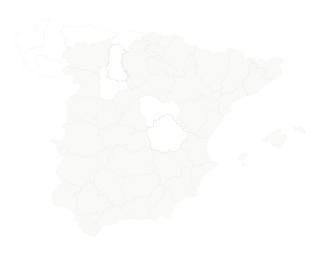
Palencia and in La Serranía de Cuenca.