Cantabrian chamois
The Cantabrian chamois is the smallest subspecies not only in Spain, but in the world. It is one of the most appreciated trophies by mountain hunters due to the difficulty of its habitat and the exclusiveness of its location.
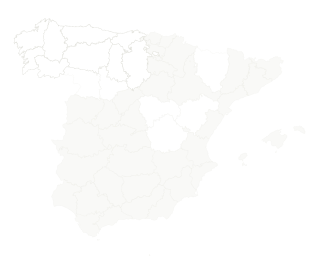
This species lives in the Cantabrian Mountains and its foothills. Their horns, present in both sexes, are hook-shaped, and their fur changes with the seasons: reddish in summer, grayish in winter. Males are distinguished by their thicker and curved horns, as well as a more robust morphology with a weight of around 20-25kg.
The heat of the Cantabrian chamois takes place between the end of October and the beginning of December, with the peak of reproductive activity normally in November. During this period, males become more active, come down from high altitudes and compete for females, which makes them easier to observe and hunt. It is a particularly interesting time to stalk adult trophies, since their behavior changes noticeably.
The natural environment where this hunt takes place is spectacular: steep mountains, deep valleys and virgin landscapes that turn each day into an unforgettable adventure. We work with local guides with deep knowledge of the terrain, to offer you an authentic, safe and completely adapted experience to your needs.
Hunting the Cantabrian chamois offers one of the most intense and authentic experiences that can be lived in the high mountains. It takes place in the rugged and majestic Cantabrian Mountains, a natural environment of great beauty that turns each day into a true adventure.
The day begins before dawn along steep trails heading to the summits. Once the first animals are located, the real challenge begins: designing an effective approach.
Chamois live in steep areas above the forest, where they feed on mountain pastures in the sun. In extreme conditions, they descend to take refuge among the trees, where they also find food. They are active throughout the day, although they tend to avoid the hottest hours.
It is common to see groups of females with young, while the more solitary males stand out especially in November, during heat, when the fights for dominance become spectacular.
Added to this experience is the exciting possibility of observing wolves or even brown bears while stalking, reminding us that we are in one of the wildest and most authentic areas of Europe. Without a doubt, this is a demanding hunt that combines excitement, pure nature and a truly special trophy.


Cordillera Cantábrica, in regions like Galicia, Asturias, Cantabria and the north of Castilla y León.